




Move to HTTP/3 and QUIC to Kill Head of Line Blocking
QUIC kills head-of-line blocking, halves the handshake, and survives a phone switching networks. The biggest wins land on the worst connections.

A customer on a train opens your app. The cell signal flickers as the train moves, packets drop, and the connection stalls. On the older web protocols, one lost packet holds up everything behind it, so a single dropped packet freezes the whole page for that user even though most of the data arrived fine. Then the train passes a tunnel, the phone switches from one tower to another, and the connection dies entirely, forcing a fresh start. That stuttering, stalling, reconnecting experience is what the previous generation of web transport delivers on a real mobile network.
HTTP/3 was designed to fix exactly this. It replaces the aging TCP foundation of the web with QUIC, a transport built for the reality of mobile and lossy networks rather than the stable wired connections TCP assumed. The result is faster connections, no stalling when a single packet drops, and sessions that survive a phone switching networks. For users on flaky connections, which is most users most of the time, the difference is the gap between a page that flows and a page that fights them.
The problem HTTP/3 solves: head-of-line blocking
The signature flaw of HTTP/2 is transport-level head-of-line blocking, and it comes from TCP. TCP delivers bytes in strict order. If packet five is lost, packets six through twenty cannot be delivered to the application until packet five is retransmitted and arrives, even if six through twenty are sitting in the buffer ready to go. HTTP/2 multiplexes many requests over one TCP connection, so when one packet drops, every request riding that connection stalls together. One lost packet, and the whole page freezes.
QUIC eliminates this. It gives each stream its own independent delivery, so a lost packet only holds up the one stream it belongs to. If the image on stream three loses a packet, the text on stream one and the script on stream two keep flowing, unaffected. Stream-level isolation means a single dropped packet no longer freezes everything behind it. On a clean wired network the difference is small, because packets rarely drop. On a mobile network where packet loss is constant, the difference is the page that keeps moving versus the page that stalls every few seconds.
Faster connections: one round trip instead of two
The second win is in the handshake, and it matters most for users far from your server or on high-latency mobile links.
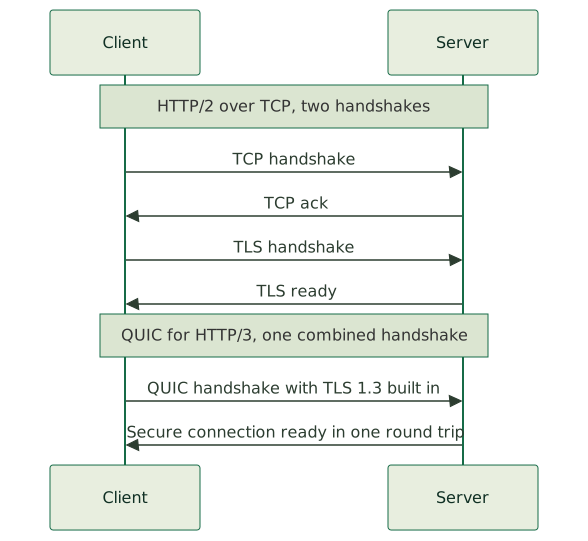
Establishing a secure connection the old way takes two separate handshakes: the TCP handshake to open the connection, then the TLS handshake to secure it. That is roughly two round trips before any actual data moves. On a cellular connection with a 120-millisecond round-trip time, those two round trips alone cost 240 milliseconds of waiting before the first byte of your content is even requested.
QUIC folds the transport and cryptographic handshakes into one. TLS 1.3 is built directly into QUIC's handshake, so opening a secure connection takes a single round trip instead of two. On that same 120-millisecond cellular link, you save 120 to 240 milliseconds on every new connection, before the page has done anything. For a user opening your site for the first time on a phone, that is a visible head start.
For returning users it gets better still. QUIC supports 0-RTT resumption, meaning a returning connection can send data immediately on the very first packet, without waiting for a handshake round trip at all. A repeat visitor's request goes out instantly, which compounds with speculation rules that make page navigations feel instant when the next page is already prefetched over that warm connection. That same 0-RTT resumption carries a subtle replay risk worth understanding before you lean on it for state-changing requests. The latency that used to sit at the front of every connection, taxing every user before they saw anything, largely disappears.
Sessions that survive a network switch
The third win is the one that directly fixes the train scenario, and it is unique to QUIC: connection migration.
A TCP connection is identified by the combination of source IP, source port, destination IP, and destination port. When a phone switches from wifi to cellular, its IP address changes, which means the four-tuple changes, which means the TCP connection is dead. The app has to detect the failure, open a new connection, redo the handshakes, and resume, and the user sees a stall or an error in the meantime.
QUIC identifies a connection by a connection ID, not by the IP and port. So when the phone moves from wifi to LTE and its IP changes, the connection ID stays the same, and the session continues without interruption. The download in progress keeps going. The page being loaded keeps loading. The user walking out of their house, off wifi and onto cellular, never notices the handoff, because to QUIC it is the same logical connection the whole time. For mobile users, who change networks constantly without thinking about it, this turns a routine source of stalls and errors into a non-event.
What the numbers say
These are not marginal improvements on real networks. Measured against HTTP/2, HTTP/3 shows up to 25 percent faster page loads and 30 to 40 percent less buffering on media-heavy pages. The gap widens exactly where you would expect, on bad connections: in high packet-loss scenarios, HTTP/3 has been measured improving mobile page load times by around 55 percent. The worse the network, the bigger the win, because HTTP/3's advantages, stream isolation, single-round-trip handshakes, connection migration, all pay off most when packets are dropping and networks are changing. The users who benefit most are the ones on the weakest connections, which is precisely the group a TCP-based stack serves worst, and the same group most affected by what a slow second costs in revenue. It pairs naturally with cutting the time before that first byte, which is where streaming server rendering slashes time to first byte takes over.
How to actually adopt it
The good news is that HTTP/3 is mostly an infrastructure upgrade, not an application rewrite. Your application code does not change; the transport underneath it does. Adoption looks like this:
- Enable HTTP/3 at your edge. If you sit behind a CDN like Cloudflare or Fastly, HTTP/3 is often a toggle, because the edge terminates the protocol and the benefit reaches your users immediately. The same edge is where pushing your CDN cache hit ratio past 95 percent compounds the gain.
- Enable it on your origin server where supported, so the benefit extends to connections that reach your servers directly. Modern nginx and other servers support QUIC and HTTP/3, though it requires the right build and configuration.
- Keep HTTP/2 and HTTP/1.1 as fallbacks. HTTP/3 runs over UDP, and a small fraction of networks block or throttle UDP, so clients negotiate the best available protocol and fall back gracefully. You are not cutting anyone off; you are giving the majority a faster path while the rest keep the old one.
- Verify it is actually negotiated. Enabling the option is not the same as users getting HTTP/3. Check that real connections are using it, via your CDN analytics or browser dev tools, because a misconfiguration can silently leave everyone on HTTP/2. This is the same field-versus-lab gap behind why your Lighthouse score lies and field data tells the truth: the only proof the upgrade reached users is in real sessions.
This is the kind of transport-layer tuning we handle as part of networking and server administration work, configuring the edge and origin so the protocol upgrade actually reaches users and falls back cleanly where it cannot, then verifying that the connections people make are really using it. It is also exactly the sort of measurable performance win we build into the websites we ship, because shaving a couple hundred milliseconds off every connection and keeping mobile sessions alive through network changes is the kind of improvement users feel even if they never know why.
The protocol your site runs on is invisible to your users, but its effects are not. On a stable office connection, the gains are modest. On the train, on the patchy cell signal, on the phone switching between networks, which is where a growing share of your traffic actually lives, HTTP/3 is the difference between a page that flows and a page that stutters. Moving the transport layer forward is one of the rare upgrades that costs you almost no application work and pays off most for the users who need it most.