



Lock Down Service Traffic With Self-Rotating mTLS
Give every internal call a verifiable identity with mTLS and self-rotating short-lived certs, so a leaked credential expires before it can be used.

Inside most backends, services trust each other because of where they are, not who they are. The billing service accepts a request from the orders service because it arrived on the private network, maybe carrying a shared secret pasted into an environment variable. That secret has not rotated since the service launched. It lives in three config files, a CI pipeline, and at least one engineer's laptop. The day it leaks, anything on the network can impersonate the orders service, and you will not know, because to billing the impostor looks exactly like the real thing.
This is the soft underbelly of a lot of otherwise careful systems. The perimeter is hardened, the public API is locked down, and behind it the services authenticate to each other with a static credential that is a single leak away from a free pass, the same brittle pattern that makes the case for keeping production secrets separated per concern so one leak does not compromise the rest. Mutual TLS fixes the underlying problem: it gives every service a verifiable cryptographic identity, and when you pair it with short-lived certificates that rotate themselves, a leaked credential stops being a breach because it expires before anyone can use it.
What mTLS actually changes
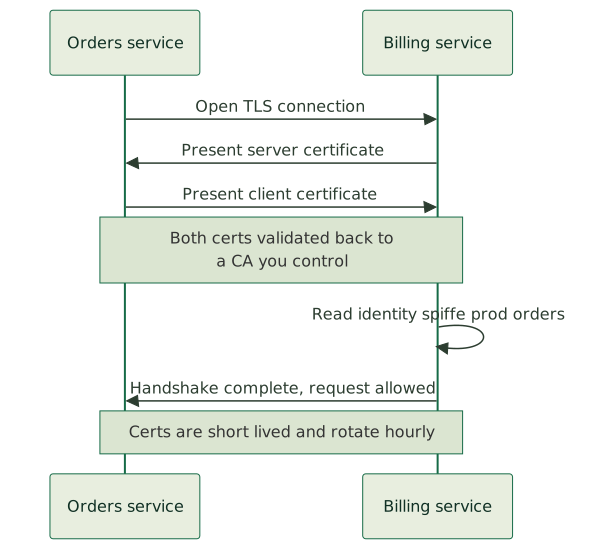
Ordinary TLS authenticates one side. When your browser connects to a bank, the bank proves its identity with a certificate and your browser checks it, but the bank has no idea who you are from the TLS layer alone. Mutual TLS makes both sides prove themselves. The client presents a certificate too, the server validates it, and the connection only completes if each side is satisfied the other is who it claims to be.
Applied between services, this is the shift from "I trust you because you are on the network" to "I trust you because you presented a certificate I can verify back to a certificate authority I control." The network location stops being the credential. The cryptographic identity becomes the credential. An attacker who lands on your internal network and tries to call the billing service gets rejected at the handshake, because they cannot present a certificate the billing service will accept, no matter where the request comes from.
That single change collapses a whole class of attacks. The leaked shared secret, the request smuggled in from a compromised neighbor, the service that should never talk to billing but technically can because it is on the same subnet. All of them fail the handshake.
Short-lived certificates are the part that matters
mTLS alone is a real improvement, but if you issue certificates that live for a year, you have mostly moved the problem. A long-lived certificate is a long-lived secret, and a leaked one is exploitable for as long as it is valid. The transformation comes from making the certificates short-lived and rotating them automatically.
The industry has converged on this hard. The SPIFFE standard, which the largest infrastructure operators use to give workloads portable identities, recommends certificate lifetimes as short as one hour. An hour. The certificate a service presents this morning is not the one it presents this afternoon. A SPIRE agent, the runtime that implements SPIFFE, watches each certificate and fetches a fresh one before it expires, transparently, with no human in the loop and no service restart.
The security consequence is the whole point. A certificate that lives one hour and rotates itself means a leaked certificate is worthless almost immediately. By the time an attacker has exfiltrated it and figured out how to use it, it has expired. This is the automated, invisible version of the same goal you chase when you rotate production secrets without taking the app down: the credential is always fresh, and rotation is never a manual scramble. You have turned the credential from a permanent liability into a disposable token, and you have done it without anyone ever manually touching a certificate again. The thing that makes mTLS operationally bearable, automatic rotation, is also the thing that makes it powerful, because short-lived only works if rotation is invisible.
In SPIFFE terms, each service gets an X.509-SVID, a short-lived certificate whose subject encodes a standardized identity (a SPIFFE ID) rather than a hostname. The billing service does not just learn that the caller has a valid certificate, it learns the caller is spiffe://prod/orders, a specific, named workload identity. Authorization decisions can then key off identity rather than IP, which is the foundation of a zero-trust internal architecture: every call carries a name you can verify and authorize, and you can scope what each identity is allowed to touch so a single compromise cannot reach everything.
You do not roll this yourself past a handful of services
Here is the honest operational warning. You can set up mTLS between two services by hand in an afternoon. Generate a CA, issue certs, configure both sides to require and validate client certificates. For two services, fine. For twenty, with rotation every hour, it becomes a full-time job of issuing, distributing, renewing, and revoking certificates, and the moment rotation slips, services start failing handshakes against each other and you have an outage that looks like a network problem.
This is why the standard answer at scale is a service mesh. Istio, Linkerd, and Consul Connect handle mTLS as a platform capability. They inject a sidecar proxy alongside each service that terminates and originates mTLS transparently, manages the certificate lifecycle including the short-lived rotation, and enforces identity-based policy, all without the application code knowing any of it is happening. The service makes a plain call to another service and the mesh wraps it in mutual TLS underneath. For more than a handful of services, rolling your own is operational pain that a mesh removes.
The decision, then, is not "mTLS yes or no" but "where on the spectrum." A few services with a clean internal API can run hand-managed mTLS with an automated issuance tool. A sprawling microservice estate wants a mesh. Either way the goal is the same: every internal call carries a verifiable, short-lived identity, and no service trusts another based on network position.
How this fits a real security posture
mTLS is one layer, and it earns its place by closing the gap that perimeter security leaves open. You harden the edge, issue JWTs attackers cannot forge or replay to authenticate users at the public API, and then mTLS authenticates the services to each other so the inside of the system is not a soft, flat, trusting network where one foothold reaches everything. The principle is the same one that runs through good security design generally: do not let location be a credential, and do not let any single leaked secret be a permanent skeleton key. When something does go wrong, audit logs that survive an incident let you reconstruct which verified identity made each call.
It also pairs naturally with the safety thinking we build into systems that take consequential actions. Our AI site-reliability engineer, LadenX, classifies every command and refuses the destructive ones without human sign-off, on the same instinct: the dangerous capability needs a check that a leaked credential or a confused caller cannot satisfy alone. mTLS applies that instinct to the wire. A short-lived, verifiable identity on every call means the system can reason about who is asking, not just that someone on the network is asking.
When we run a security audit or design the network architecture for a server administration engagement, internal service-to-service auth is one of the first things we look at, because it is one of the most common gaps. The public surface gets the attention. The trusting internal network, held together by a static secret nobody has rotated, is where a contained breach becomes a total one. Closing that gap is part of what a small team needs in place before its first security incident, so a foothold does not turn into a free run of the whole estate.
The shift worth making
Move your internal services off "trust by location" and onto "trust by verifiable identity." mTLS gives each service a certificate the other side can check back to a CA you control, so an attacker on the network cannot impersonate anything. Make those certificates short-lived, an hour rather than a year, and rotate them automatically, so a leaked certificate expires before it can be used. And past a few services, let a mesh carry the operational weight rather than managing certificates by hand.
Do that and a stolen credential stops being a breach. It becomes a token that was already dead by the time anyone tried to use it, which is exactly what you want every secret in your system to be.