




What Teams Get Wrong Shipping to African Markets
Mobile money, latency, and device reality decide adoption here; design for them upfront or lose the market to an afterthought.

A team builds a polished product, gets it working beautifully on their own laptops and their own fast connections, points it at an African market, and watches it fail to gain traction. They conclude the market is not ready, or that adoption is just slow here. Usually the truth is the reverse. The market was ready and growing fast, but the product was built for a user who does not exist in that market: someone with a flagship phone, unlimited fast data, a credit card, and a server next door. Design for the user who is actually there, and the same market that rejected the first version takes the second.
Africa is not a slow or reluctant software market. It is one of the most dynamic payment markets on earth. Sub-Saharan Africa alone holds more than 1.1 billion registered mobile money accounts, and the continent processed around 1.1 trillion dollars in mobile money transactions in 2024, with instant payment systems now live across dozens of countries moving close to two trillion dollars a year. The demand is enormous and accelerating. What loses teams the market is not a lack of appetite. It is a set of assumptions baked into their product that quietly exclude the people they are trying to reach.
Payments: mobile money is the rail, not a fallback
The single most consequential assumption a team imports is that payment means a card. In much of Africa, it does not. Mobile money is the primary financial rail, not a secondary option you add later. A product that treats card payment as the main path and mobile money as an afterthought has the architecture backward for the market, because the card is the rare instrument and mobile money is the common one.
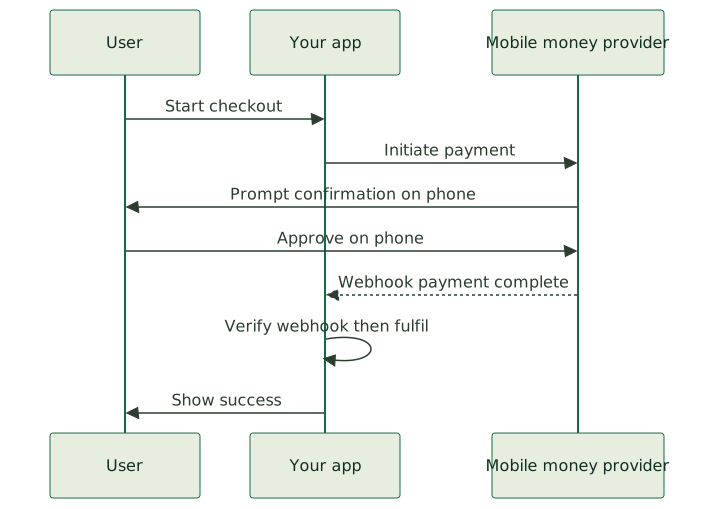
This is not a minor integration detail. It shapes the entire payment flow. Mobile money transactions work differently from card transactions, often involving a confirmation step on the user's phone, an asynchronous flow where the payment completes out of band through a webhook you must verify before it moves money, and providers that vary by country. Building this as a first-class payment path, with the right local providers, the right confirmation handling, and a flow that fits how mobile money actually works, is the difference between a checkout that converts and one that strands users at the moment they were ready to pay. A useful adoption pattern to know: individuals adopt digital payments faster than merchants in emerging markets, so the consumer side of your product will often be ready before the merchant side, and your onboarding should account for that gap, getting a new user to their first win before they think of leaving even when the merchant flow is still maturing.
Latency: your server's distance is a tax your users pay
The second assumption is proximity. A team building in a region with nearby data centers does not feel latency, so they do not design against it, and then their users in Accra or Lagos connect to a server an ocean away and feel every round trip. The distance between your origin and your user is a real cost, paid on every request, and for a user far from your server it adds up into a product that feels sluggish even when your code is fast.
The fix is to serve users from near where they are, through a CDN that caches near them and latency-based DNS routing that sends them to the closest healthy origin, so a user in West Africa is not waiting on a server in another hemisphere. This is the same geographic discipline any global product needs, and it matters more, not less, when your audience is concentrated in regions far from the typical default data center. Getting this right is part of how we think about networking for products serving African users, because a fast first byte for a user in Accra requires deliberately putting infrastructure within reach of Accra rather than assuming the default location serves everyone equally.
Device and data reality: build for mobile-first and low-bandwidth
The third assumption is the device and the connection. Teams test on recent phones over fast WiFi and ship an experience tuned for that. The actual user is often on a mid-range or older device, over mobile data, on a connection that is slower and less reliable, and paying for every megabyte. A heavy app that loads fine on a flagship over WiFi is a heavy app that loads slowly, drains data the user is paying for, and frustrates the person you are trying to reach.
Building for this reality is concrete, not abstract.
- Keep the payload small. Every megabyte you ship is data your user pays for and time they wait on a slower connection. Lean bundles, shrinking your Next.js bundle with server components that ship zero JS, optimized images, and taming the third-party scripts wrecking your page speed are not optimizations here, they are requirements for the product to be usable.
- Work on low bandwidth and tolerate interruption. Connections drop and recover. A product that survives bad networks with offline-first sync, saves state, and resumes beats one that assumes a stable pipe and breaks when it is not there.
- Target mid-range and older devices. Test on the hardware your users actually have, not the hardware you have. A product that is smooth on a flagship and janky on a common mid-range phone is janky for most of your market.
- Respect data cost in the experience. Auto-playing video, eager preloading, and heavy assets are not just slow, they spend money the user did not agree to spend. Default to lean and let the user opt into heavy.
This is exactly where a progressive web app often beats a heavy native app for your budget and for African reach: it installs from a link with no store friction, it can be built light, and it works across the range of devices people actually carry. When we plan mobile apps and web apps for this market, the device and data reality shapes the platform decision from the start rather than being discovered after launch.
Why this is a design-upfront problem, not a localization pass
The reason these issues sink products is that they cannot be retrofitted cheaply. Payment architecture, geographic infrastructure, and a lightweight experience are foundational decisions. A team that builds card-first, server-far, and heavy, then tries to bolt on mobile money, add a CDN, and trim the bundle after launch, is doing major surgery on a product that already failed its first impression with the market. The users who tried the slow, card-only, heavy version and left do not come back for the patched one.
Designing for the market upfront is not extra work layered onto a "normal" build. It is building the right thing the first time: mobile money as a first-class payment rail, infrastructure positioned near the users, and an experience tuned for real devices and real data costs. Do that, and the product meets a market that is large, growing fast, and genuinely eager for good software. Skip it, and you ship a product built for a user who is not there and conclude, wrongly, that the market was the problem.
The teams that win in African markets are not the ones with the most features. They are the ones who understood that the user has a different phone, a different payment rail, a different connection, and a different relationship to data cost, and built for that user from the first line. The appetite is there. The market is moving trillions. What it rejects is software that was clearly built for somewhere else and pointed here as an afterthought. Build for who is actually there, and the same market opens.