



Teach an AI SRE to Diagnose Root Cause, Not Restart
Why naive auto-restart loops mask incidents and how to build an agent that finds and fixes the actual failing layer.

The simplest possible self-healing system is a loop that restarts a service when its health check fails. It is also, much of the time, the worst possible one, because it does the one thing that hides the problem instead of fixing it. A service that crashes because it ran out of memory will crash again the moment it fills up again. A service that crashes because the database it depends on is down will keep crashing, restarting, and crashing, because restarting a healthy service does nothing about an unhealthy dependency. The restart loop turns a clear, diagnosable failure into a noisy, recurring one that masks the actual cause.
Building an AI system that operates production well means resisting the temptation to make it a smarter restart button. The valuable thing an autonomous operator does is not act faster than a human; it is diagnose correctly, find the layer that is actually failing, and fix that. Here is the difference between an agent that restarts the symptom and one that resolves the cause, and why that difference is the whole point.
Why naive auto-restart is worse than nothing
A restart is the right remediation for exactly one class of failure: a process that has gotten into a bad transient state and would be fine on a clean boot. For everything else, restarting is at best a stall and at worst actively harmful.
The harm is in what it conceals. When an incident keeps getting auto-restarted, the dashboard shows a service flapping between up and down, the alerts fire and clear and fire again, and the real signal, the database connection pool is exhausted, the disk is full, an upstream dependency is timing out, gets buried under the restart noise. The team loses the clean failure they could have diagnosed and inherits a recurring one they have to fight. Mean time to resolution goes up, not down, because the loop is spending the incident's most useful minutes papering over the evidence.
There is a measurable cost to getting this right instead. Organizations that move from naive remediation to accurate root-cause identification see large drops in repeat incidents, because fixing the actual cause means the same incident does not come back next week. A restart loop optimizes for the opposite: it makes the incident come back, quietly, forever, and every recurrence carries whatever an hour of downtime actually costs your business.
The work an autonomous operator actually has to do
A useful AI site-reliability engineer does the thing a good human on-call does, in the order a good human does it. The order matters because acting before diagnosing is how you make things worse.

Gather context across layers. A failure surfaces in one place and originates in another. The web tier returns 502s, but the cause is the application tier, or the database, or the disk, or a dependency three hops away. The agent has to look across the stack, correlating what the load balancer sees with what the application logs say with what the host metrics show, rather than reacting to the single symptom that happened to trip the alert. This is only possible if the system was instrumented for it in the first place, which is what instrumenting your app so you find the root cause in minutes not hours and seeing exactly what your agent did when it goes off the rails are about. Mapping incidents across systems to find the real dependency is exactly what separates root-cause analysis from symptom-chasing.
Form a hypothesis and confirm it. "The service is down" is not a diagnosis; it is an observation. "The service is down because the connection pool is exhausted, and the pool is exhausted because a slow query is holding connections open" is a diagnosis, and it points at a specific fix. The agent should reach a stated, evidence-backed conclusion about which layer is failing and why, and be able to show its work, before it touches anything.
Fix the cause, not the surface. Only once the failing layer is identified does remediation make sense, and the remediation should target that layer. If the disk is full, clear the disk; restarting the app does nothing. If a runaway process is starving the host, deal with the process. If, and only if, the diagnosis is genuinely "the process is wedged and a clean restart resolves it," then restart, and even that restart should be a zero-downtime reload rather than a hard bounce, because now it is the correct fix rather than a reflex.
This sequence, observe across layers, diagnose to a root cause, then remediate the cause, is what modern incident automation is built around, with contextual analysis and dynamic runbooks replacing the blunt restart. The agent that follows it resolves incidents; the agent that skips to remediation just relocates them.
The diagnosis is the hard part, and it is the valuable part
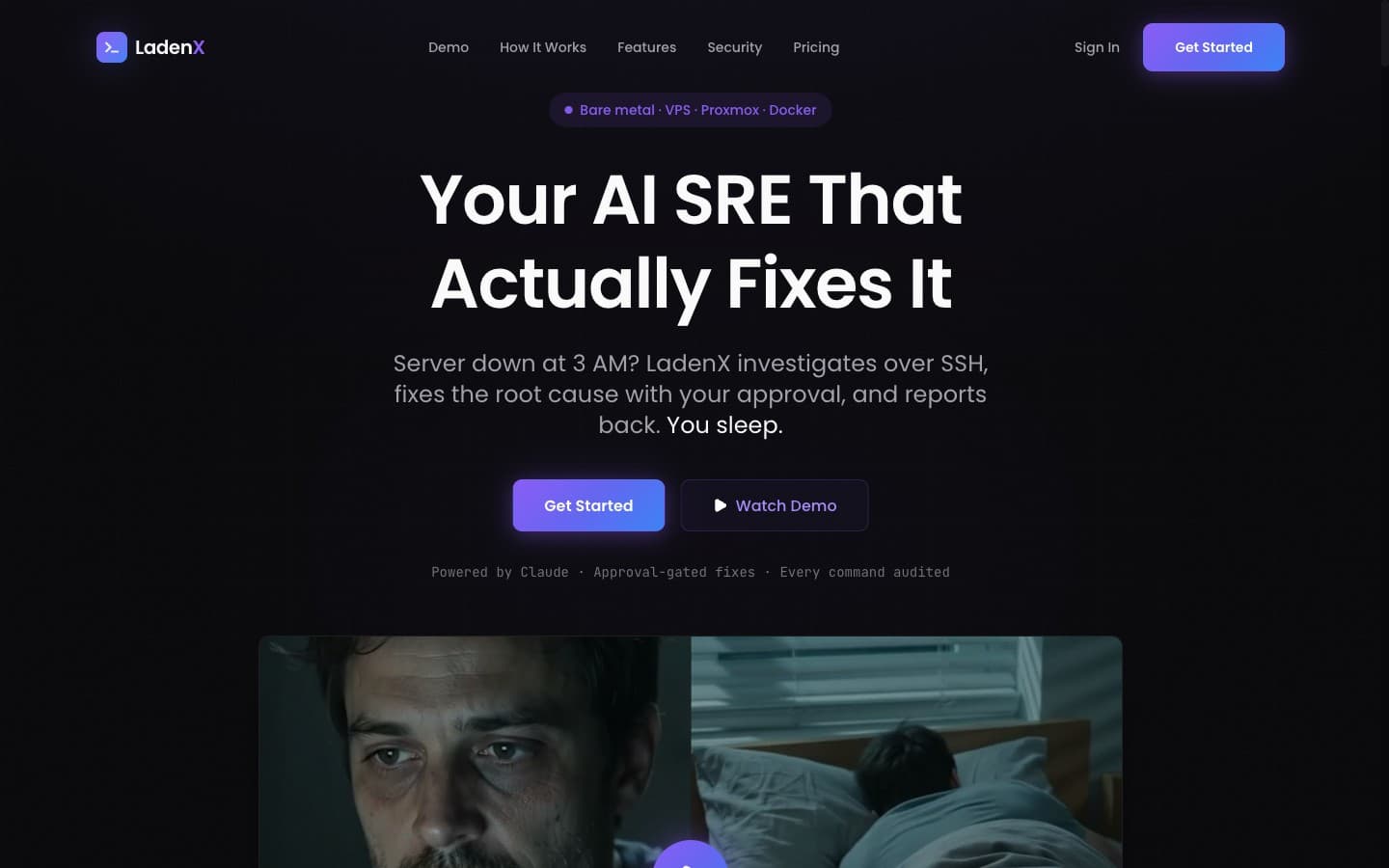
When we built LadenX, the AI site-reliability engineer, the principle we kept coming back to is that the impressive move is the diagnosis, not the action. Anyone can write a script that restarts a service. The thing that is hard, and the thing that actually earns trust, is an operator that looks at a site returning errors and works out that the real problem is, say, a configuration change that broke a dependency, then fixes that root cause so the failure does not recur, instead of bouncing the process and watching it fall over again two minutes later.
This is why a demo of an autonomous operator should lead with the diagnosis. A site goes down. A naive tool restarts it and the site comes back, until it does not, because the underlying cause is still there. A real operator examines the failure, identifies the actual broken layer, repairs it, and the site stays up, because the thing that was wrong is no longer wrong. The difference a skeptic cares about is not speed; it is whether the fix holds. A restart that masks the cause does not hold. A repair that addresses the cause does.
Guardrails are not optional when an agent can act on production
An autonomous operator that can fix root causes is, by definition, an autonomous operator that can run commands on production. That is exactly as dangerous as it sounds, and the design has to take it seriously, because the same capability that lets the agent clear a full disk lets it delete the wrong thing.
The guardrail we built into LadenX is that it classifies every command before running it and refuses destructive ones without a human signing off. A read-only diagnostic command, tailing a log, checking disk usage, inspecting a process, runs freely, because it cannot hurt anything. A command that deletes data, drops a table, or does anything irreversible stops and asks for explicit human approval first. The full design of that gate is the subject of giving autonomous fixes guardrails before they touch production, and the same exactly-once care applies to any remediation that itself has side effects, as in making agent tool calls idempotent before they double-charge a customer. This is what makes an autonomous operator something you can actually point at production: it can do the safe, high-value diagnostic and remediation work on its own, and it cannot do the catastrophic thing without a person in the loop.
The reframe that matters here is that the safety is a selling point, not a limitation. The fear with any autonomous system is "what if it does something terrible," and the answer is that the careful operator does the safe thing instantly and asks before anything risky. Powerful and careful are not in tension; the classification gate is what lets the agent be both. Building those guardrails into how an agent takes action, rather than hoping it never reaches for the dangerous command, is the foundation of AI automation you can trust on real infrastructure.
What a good autonomous operator looks like in practice
Picture the failure at 3am that nobody is awake for. A naive auto-restart loop would catch the crash, restart the process, watch it crash again because the cause is still present, and leave a morning of flapping alerts and a still-broken service for the team to untangle.
A real autonomous operator catches the same crash, but instead of reflexively restarting, it looks across the stack, correlates the application errors with the host metrics and the dependency state, and concludes the actual cause. It fixes that layer, the disk, the dependency, the configuration, whatever the evidence points to. It restarts only if a clean restart is genuinely the correct remedy. And if the fix requires anything destructive, it pauses and asks a human before proceeding. The team wakes up to a resolved incident and a clear account of what was wrong and what was done about it, not a mess of restart noise hiding a problem that is still there.
That is the bar. Not a faster restart button, but an operator that diagnoses like a good engineer and acts with a good engineer's caution. Pushed far enough, this is how AI site reliability cuts your on-call burden to near zero. The restart loop optimizes for looking busy. A real autonomous operator optimizes for the incident actually being over.