



How AI Site Reliability Cuts Your On Call Burden To Near Zero
What an autonomous SRE catches and fixes automatically, and which incidents still need a human at three in the morning.
On-call is the tax engineers pay for running software that people depend on. The pager goes off at 3am, you stumble to a laptop, and most of the time the fix is something you have done a hundred times before: a service that needs restarting, a disk filling up, a connection pool exhausted, a deploy that needs rolling back. The incident did not require deep insight. It required someone awake to perform a known action quickly. That gap, between "a human had to be awake" and "the fix was routine," is exactly what an AI site-reliability engineer closes.
The promise is not that machines will handle every incident. It is that they will handle the large, repetitive majority, the alerts that have an obvious cause and a known remedy, so that the small minority that genuinely need a human's judgment are the only things that wake you. Done well, autonomous ops does not eliminate on-call, it shrinks it to the incidents that were actually worth getting up for.
What an autonomous SRE actually catches and fixes
Start with what is real, because there is a lot of hype in this space. The capabilities that hold up in production are concrete.
The first is noise reduction. A huge fraction of on-call pain is not incidents, it is alerts, dozens of pages for a single underlying problem, each one a separate interruption. This is exactly what structured logging that turns into alerts you trust is meant to prevent. AI-driven event correlation groups related alerts into a single incident, so one root problem produces one page instead of forty. Teams using AI correlation report markedly less alert noise, which directly attacks the fatigue that makes on-call miserable in the first place. Fewer, better pages is a win before any automated fixing even happens.
The second is auto-remediation. When an incident has a known runbook, the system can execute that runbook, or coordinate the corrective action, without waiting for a human to wake up and do it by hand. Restart the stuck process, clear the full log directory, fail over to a healthy instance, roll back the bad deploy, the same routine fixes that a self-healing deploy script handles when a health check fails. In production deployments, AI ops platforms have auto-handled a large majority of alerts and cut mean time to resolve dramatically compared to manual processes, surfacing the genuinely critical issues within seconds while quietly handling the routine ones. The routine incident that used to cost you a night now gets resolved before you would have even seen the page.
The third is diagnosis. Even when a human does need to act, an autonomous SRE that has already investigated, correlated the signals, identified the likely root cause, and proposed a fix turns a 40-minute groggy investigation into a 5-minute review of work already done. The human approves and moves on, instead of starting cold.
Which incidents still need a human at 3am
Honesty matters here, because an autonomous SRE that oversells itself is worse than none at all. There are incidents that should still wake a person, and a well-designed system knows the difference and escalates rather than guessing.
A genuinely novel failure, something with no runbook, an unfamiliar cause, a pattern the system has not seen, needs human investigation. Automation is good at known problems; the unknown is where judgment earns its keep. An incident where the safe fix is ambiguous, where the obvious action might make things worse or the right call depends on business context the machine does not have, belongs to a human. And any incident whose remediation is destructive or irreversible, anything that drops data, deletes a volume, or makes a change that cannot be cleanly undone, must wait for explicit human sign-off, no matter how confident the system is.
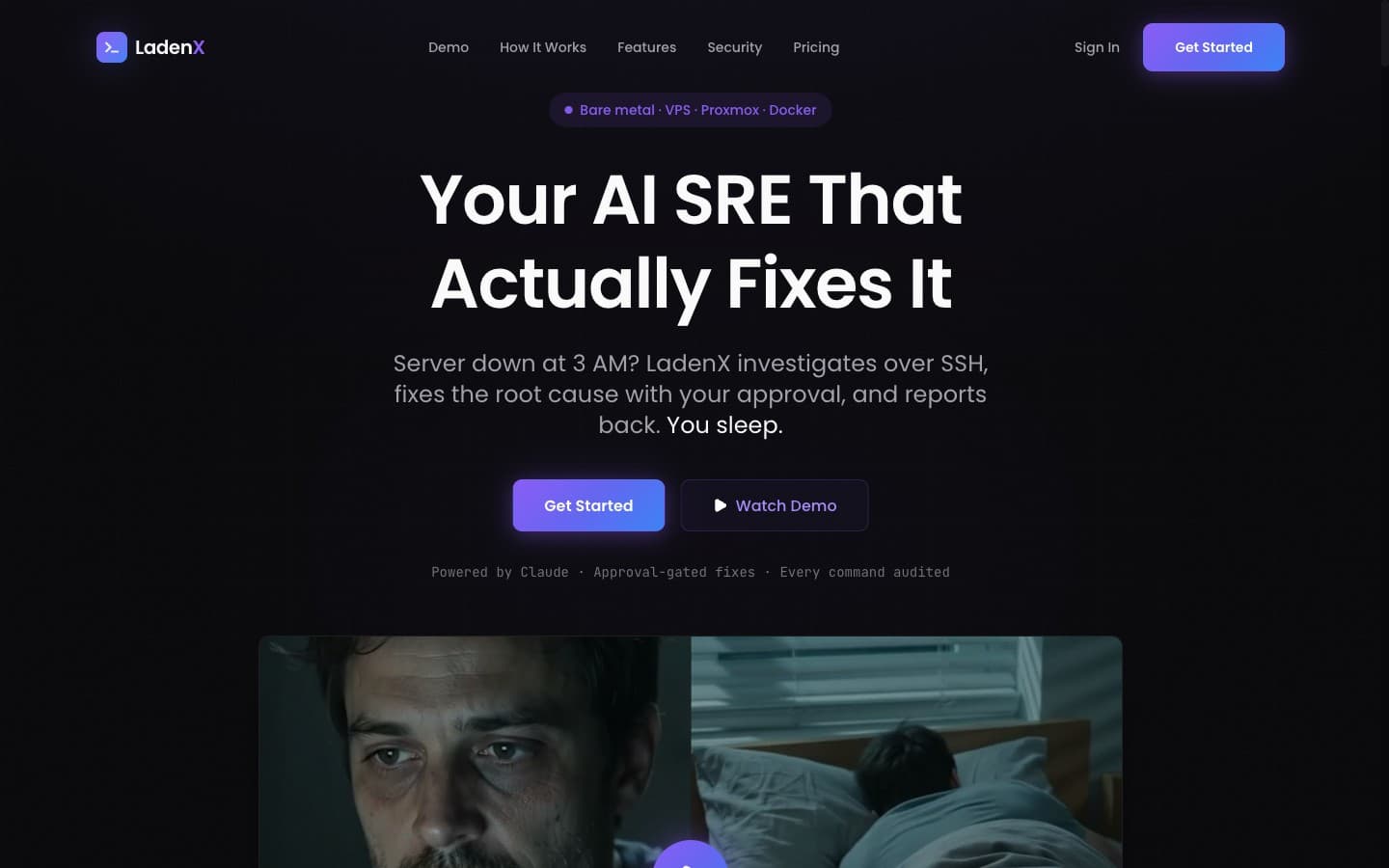
That last category is the non-negotiable line. This is the heart of how we built LadenX, our AI site-reliability engineer: it classifies every command before executing it and refuses destructive ones without human approval, the guardrails an autonomous fix needs before it touches production. The agent can investigate freely and take the safe corrective actions on its own, but a command that could cause irreversible harm hits a wall and pages a human. The autonomy is bounded by the danger of the specific action, which is what makes it trustworthy enough to run unattended on the routine stuff.
The escalation is the product

The right way to think about an autonomous SRE is not "it fixes everything." It is "it triages everything and fixes what is safe and known, escalating the rest with its homework done." The system handles the large bottom of the incident pyramid, the volume of routine, known-cause alerts, entirely on its own. It handles the middle, the actions with real consequences, by proposing a fix and getting a human's one-tap approval. It hands the top, the novel and the irreversible, straight to a human, but with a correlated, diagnosed, root-caused incident instead of a raw flood of alerts.
The result is that your on-call rotation stops being about staying awake to perform routine fixes and becomes about being available for the genuinely hard or genuinely dangerous calls, which are far rarer. The 3am page you still get is one that was actually worth getting up for, and it arrives with the investigation already done.
Adopt it as a curve, not a leap
You do not flip a switch and hand production to an agent overnight, and any vendor who suggests you should is selling risk. The sane path is a maturity curve. Begin with the system read-only, correlating alerts and surfacing insights so you trust its understanding. Then let it advise, telling you what it would do. Then approval-based remediation, where it proposes and you confirm. Only the safest, most proven, most well-understood actions ever graduate to fully autonomous, and the destructive ones never do.
Each stage earns the next by demonstrating reliability on that class of incident. This is how trust gets built honestly, by widening authority only where the track record supports it, and it is how you end up with a system that is autonomous on the routine without ever being autonomous on the irreversible.
What you actually get back
The honest accounting of autonomous ops is not "no more on-call." It is "your on-call burden drops toward zero for the incidents that were never worth a human's night, and stays exactly where it should for the ones that are." The pages that used to be a restart you performed half-asleep get handled before you wake. The flood of correlated alerts collapses into single, meaningful incidents. The hard calls still come to you, but rarely, and with the groundwork laid.
That is the difference an AI site-reliability engineer makes: not a promise to replace your judgment, but a system that does the relentless watching and the routine fixing so your judgment is spent only where it matters. Done consistently over time, it is also what turns uptime into a competitive moat no rival can copy by watching you. We built LadenX to be exactly that, an SRE that runs around the clock, fixes what is safe and known, and refuses to touch anything irreversible without a human in the loop, the same discipline behind handing your deploy pipeline to an agent and still sleeping at night and how we administer servers. The point was never to remove the human. It was to stop waking the human for things that never needed one.