



Hand Your Deploy Pipeline to an Agent and Still Sleep at Night
Wrap build, health-check, and auto-rollback so an agent ships safely, with destructive actions gated behind human approval.

There is a version of "let an AI handle the deploy" that should terrify any engineer, and a version that lets you sleep better than you do now. The terrifying version is an agent with unlimited authority running commands on production with no checks, free to drop a table or restart the wrong service because it misread the situation. The reassuring version is an agent that does the repetitive, error-prone mechanics of a deploy, build, health-check, watch, and roll back, inside a structure that makes the dangerous actions impossible to take without a human saying yes.
The difference between those two is not how smart the agent is. It is how the pipeline around it is built. An agent shipping code safely is mostly a story about guardrails: what the agent is allowed to do on its own, what it must ask permission for, and what happens automatically when something goes wrong. Get that structure right and you can hand off the tedious parts of deployment without handing off the judgment.
Why automate the deploy at all
A manual deploy is a sequence of steps that humans get wrong precisely because they are routine. Pull the code, install dependencies, run migrations, build, restart the process, check the health endpoint, watch the error rate, and if something looks off, roll back fast. None of it is hard. All of it is easy to fumble at 11pm under pressure, skip a step, forget to check the health endpoint, hesitate on the rollback while users hit errors. The repetitive, high-consequence nature of the work is exactly what machines do more reliably than tired humans.
So the goal is not to replace the engineer's judgment about whether to ship. It is to make the mechanics of shipping deterministic and the recovery automatic, so the human spends their attention on the decision that matters and not on remembering the runbook.
The pipeline does the mechanics deterministically
Before an agent enters the picture, the deploy itself should be a single reliable script with the safety baked in. The shape we use on every deploy looks like this:
- Capture the current commit, so rollback has a known-good target.
- Pull the new code and stash anything uncommitted so the pull cannot fail halfway.
- Install dependencies and run migrations.
- Build into a fresh output, and verify the build actually succeeded with an explicit success marker, not just an exit code.
- Restart the process under its proper user, mindful of the PM2 multi-daemon trap that breaks a deploy when ownership is wrong.
- Curl the health endpoint, retry a few times to allow for warm-up, and if it never comes healthy, automatically roll back to the captured commit.
That last point is the keystone. The pipeline auto-rolls-back on a failed health check. The new version does not get to stay live if it cannot answer that it is working. This is true whether a human or an agent triggers the deploy, and it means the worst case of a bad ship is a brief blip followed by an automatic return to the last good state, not an outage that waits for someone to notice and react.
Where the agent fits, and where it must stop
Now layer the agent on. The agent's job is to drive that pipeline and to respond intelligently to what it observes: notice a deploy is needed, run the steps, watch the metrics after, and propose a corrective action when something looks wrong. The canonical example, and a genuinely useful one, is an agent that detects a spike in error rate after a release and proposes rolling back to the last stable version, the same instinct behind teaching an AI SRE to diagnose root cause, not just restart the service. That detection only works if the app is instrumented to find the root cause in minutes, not hours; the agent is only as good as the signals it can read. The detection and the proposal are exactly the kind of fast, attentive monitoring a machine does well around the clock.
But the proposal is where the human re-enters. The agent does not roll back production on its own authority for a judgment call; it flags the action and the on-call engineer receives an approval notification, and a human gives final sign-off so someone accountable was in the loop for the production change. The good approval prompt is not a bare "Approve?" It surfaces what matters: what the agent intends to do, why, the expected blast radius, and the rollback plan, so the human is acknowledging a decision they actually understand rather than rubber-stamping a notification.
This is the principle that makes agentic deployment defensible: approval gates are what turn autonomy into something repeatable and safe in a system with real consequences. The agent's speed handles the watching; the human's authority handles the decisions that can hurt.
Classify every action by how dangerous it is
The structural idea underneath all of this is that not every action carries the same risk, and the pipeline should treat them differently. Reading logs, checking a health endpoint, pulling code, these are safe and the agent can do them freely. Restarting a service, rolling back, running a migration, these have real consequences and warrant a human in the loop depending on context. Destroying data, dropping a table, force-pushing, deleting a volume, these are the actions that should never happen without explicit, unambiguous human sign-off, full stop.

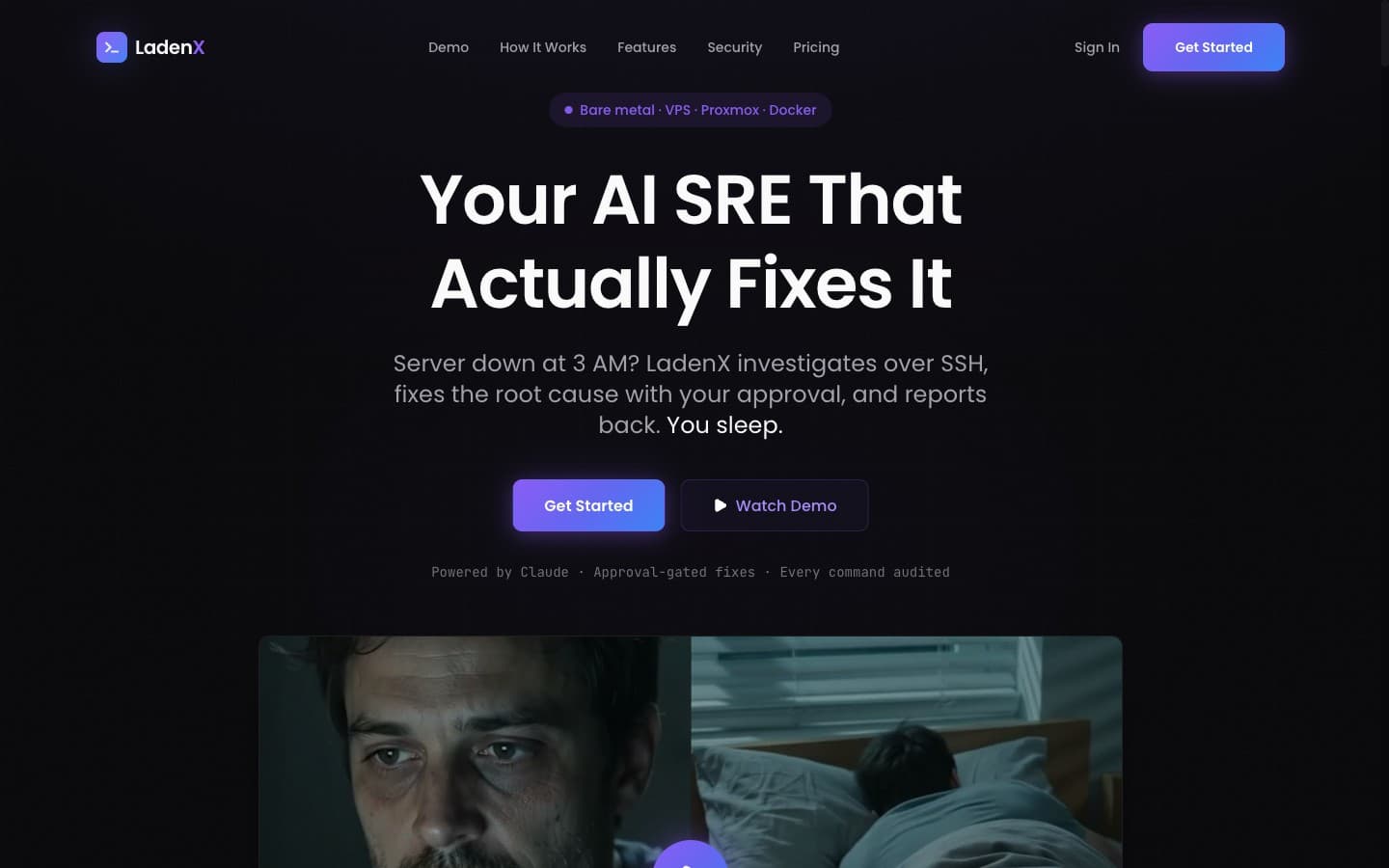
We built our AI site-reliability engineer, LadenX, around exactly this idea, the same way we give autonomous fixes guardrails before they touch production. It classifies every command before it runs and refuses destructive ones without human sign-off. The agent can investigate freely, take the safe corrective actions, and move fast, but a command that could cause irreversible harm hits a wall and waits for a person. That classification is the whole safety model: the agent's autonomy is bounded by the danger of the specific action, not granted or withheld wholesale. A read is fine to do instantly. A destroy is never fine to do alone.
The maturity curve, not a single switch
You do not flip from manual to fully autonomous overnight, and you should not try. The sane adoption path is a curve. Start with the agent in read-only mode, surfacing insights and flagging what it sees. Then let it advise actions, telling you what it would do. Then move to approval-based remediation, where it proposes and you confirm. Only the safest, most well-understood actions, with strong guardrails and a proven track record, ever graduate to fully autonomous. Each step earns the next by demonstrating the agent's judgment is reliable on that class of action, and at the far end of that curve sits the goal of AI site reliability that cuts your on-call burden to near zero.
This is how you build trust honestly, by widening the agent's authority only where it has proven it deserves it, and keeping the irreversible actions gated permanently. The engineer stays in control of the decisions that matter while offloading the relentless, repetitive watching to something that never gets tired or distracted.
Sleep, earned
Handing your deploy pipeline to an agent is not reckless if the pipeline is built to make recklessness impossible. The deploy script auto-rolls-back on a failed health check. The agent watches around the clock and proposes corrective actions. The dangerous actions are classified and gated behind explicit human approval. The agent's authority grows only as far as its track record allows.
Built that way, the agent takes the 3am mechanical toil and the constant vigilance off your plate, and leaves you exactly the judgment a human should keep. That structure, the classification, the gates, the automatic rollback, is what we build into how we deploy and run software and into LadenX itself. The point of automating the deploy is not to remove the human. It is to remove everything except the human's judgment, and to make a bad ship a contained blip instead of a long night.